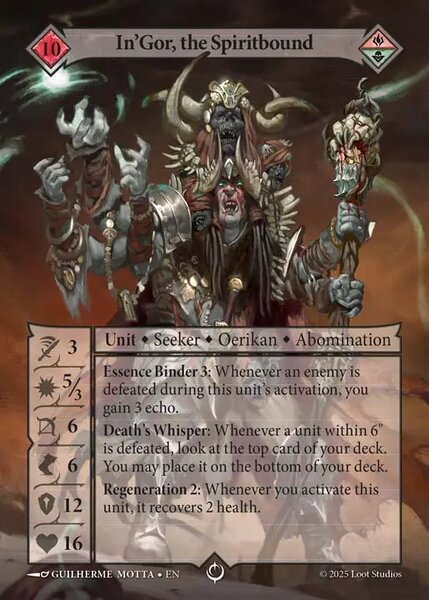
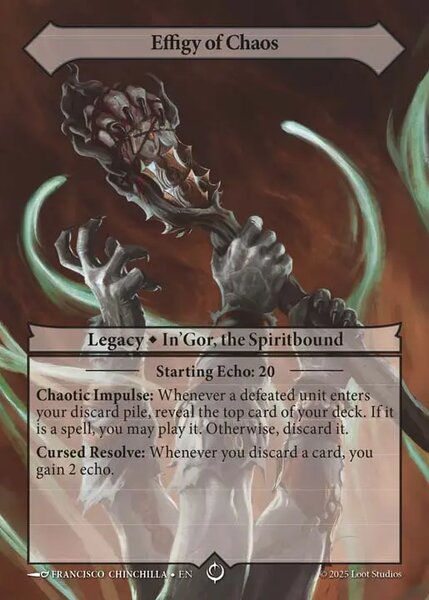
In'Gor, the Spiritbound has a 60.0% win rate as an aggressive swarm deck.
So naturally, no one at Gen Con 2026 expected an In’Gor deck with minimal units to perform very well.
At first glance, it looks like the In’Gor player (Woody) forgot what their Seeker was supposed to do.
They didn’t, they were building a combo deck.
A list that goes 3-1 and finishes tied for second at GenCon doesn't need defending. But the decklist itself looks like it's missing something: bodies.
In'Gor is an aggressive swarm Seeker. You expect units and lots of them. Instead, it is packed with spells.
Underneath the low unit count and the spell-heavy shell is our first glimpse at a combo deck, one built to turn a unit's death into a chain reaction that spells doom for the opponent.
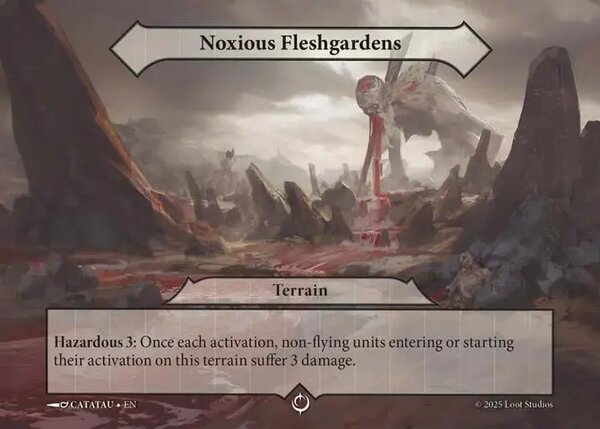
At a glance, the ratios feel off , this is not a swarm deck that happens to run some removal. Instead it is the first combo deck Malediction has ever seen. The "thin" unit count and "bloated" spell suite are exactly what the engine needs to function.
Most decks in Malediction win by building an advantage over several turns. They establish units, trade resources, and gradually push the opponent off the board.
Combo decks play a different game.
They spend several turns assembling pieces, then attempt to convert those pieces into one overwhelming sequence of actions.
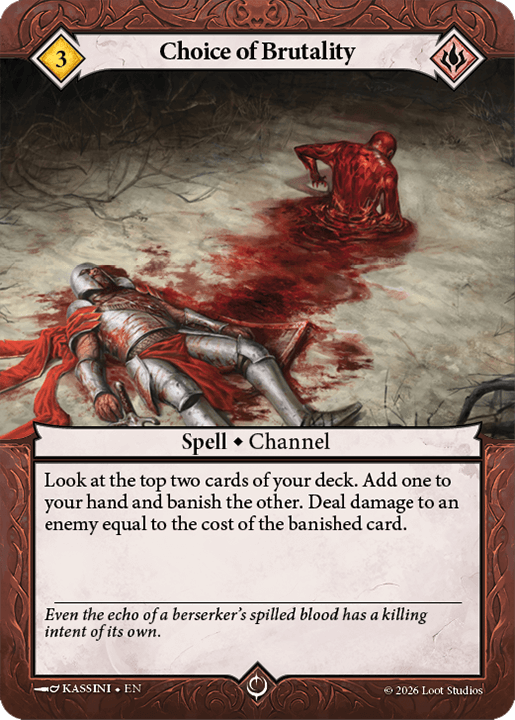
This deck is built around that idea: one unit dies, which allows you to cast a spell, which causes more damage, which causes more deaths, which gives the deck more opportunities to cast more spells.
Three cards do the actual work, and each has a distinct job.
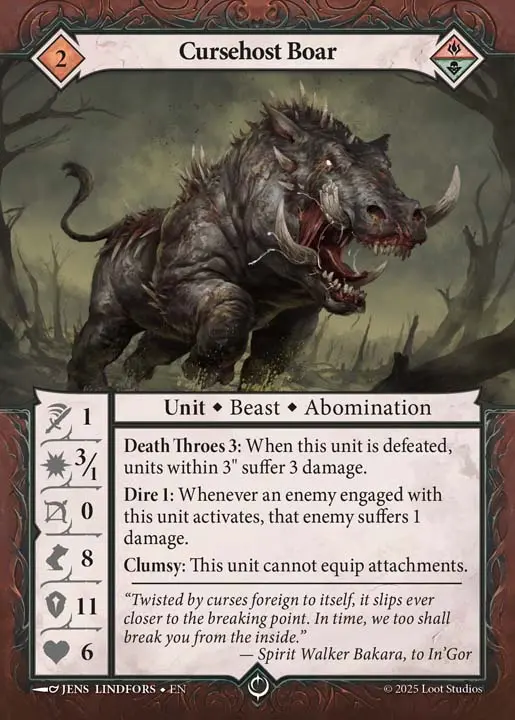
Cursehost Boar isn't early pressure here so much as fuel, a unit the deck wants to feed into its own Legacy on purpose.
Effigy of Chaos, In'Gor's Legacy, is the payoff piece:
Whenever a defeated unit enters your discard pile, reveal the top card of your deck. If it is a spell, you may play it. Otherwise, discard it.
In'Gor's own ability, Death's Whisper, is the control valve on that engine:
Whenever a unit within six inches is defeated, look at the top card of your deck. You may place it on the bottom of your deck.
This allows you to filter the top card before you reveal the spell you want to cast.
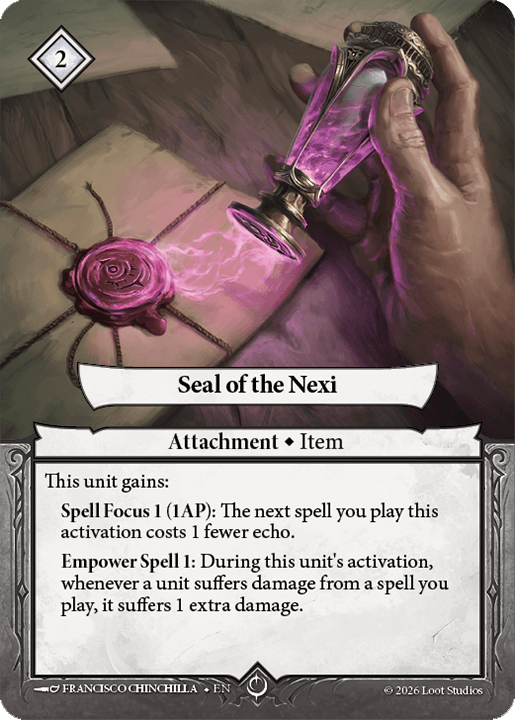
Seal of the Nexi and Woe-Caster Shaman. Seal of the Nexi carries Empower Spell 1:
During this unit's activation, whenever a unit suffers damage from a spell you play, it suffers 1 extra damage.
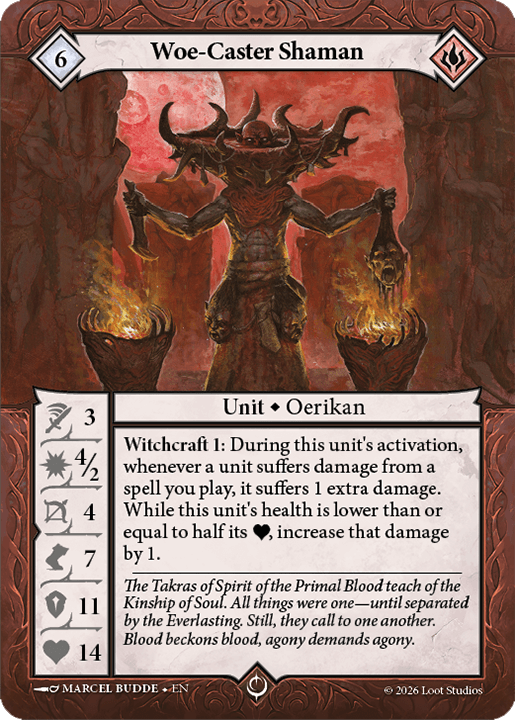
Woe-Caster Shaman runs a matching effect, Witchcraft 1, with an added clause:
While this unit's health is lower than or equal to half its health, increase that damage by 1.
A wounded Woe-Caster with a Seal of the Nexi can stack Empower Spell 1 and Witchcraft 1 for an additional 3 damage on your spells, as they are two different abilities.
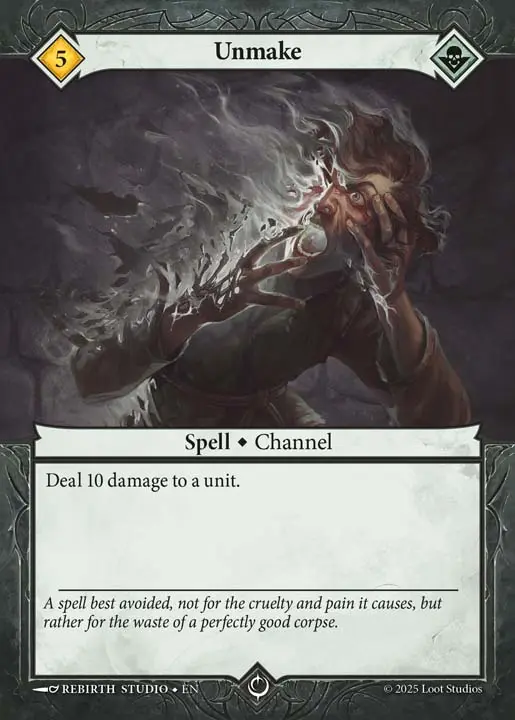
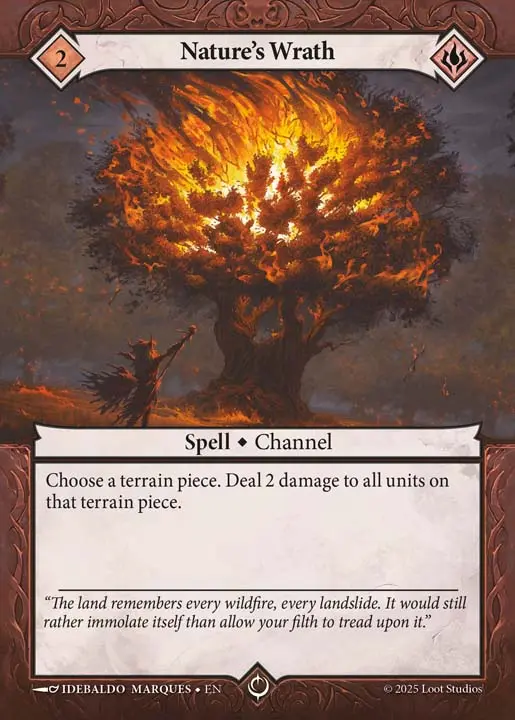
None of these pieces does much alone. Combined together, they turn a unit's death into a power house explosion that can start flipping more damage spells off the top of the deck ready to be cast and continue the chain.
Play Corpse Explosion
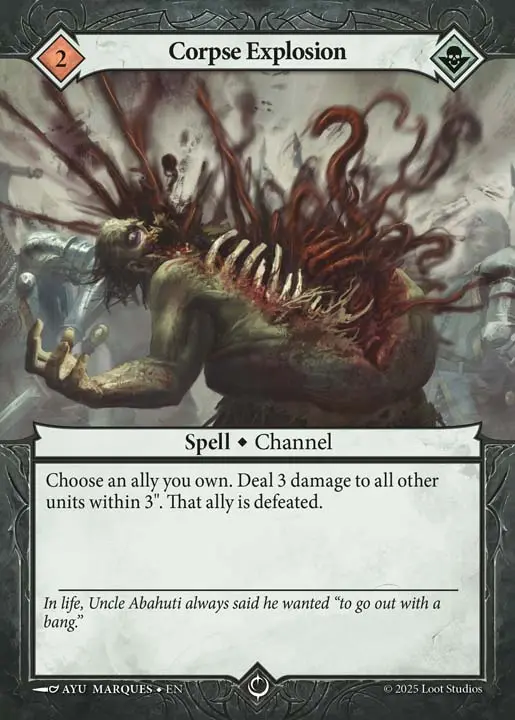
Target your Cursehoast Boar
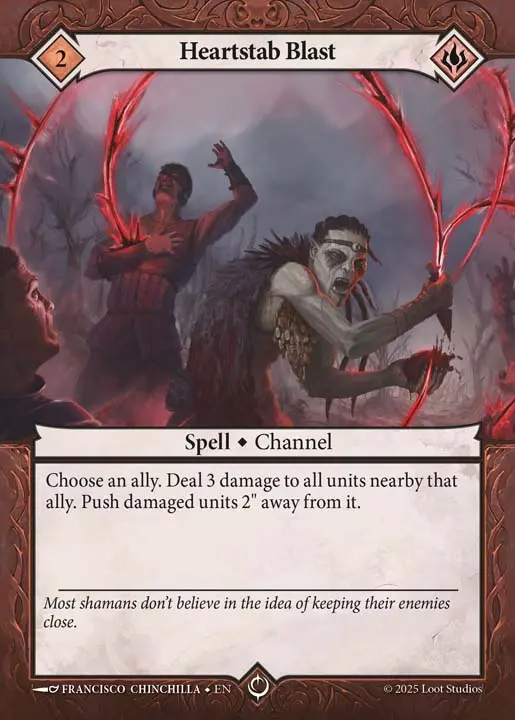
3 damage is dealt to all units within 3 inches of the boar (more with a Woe-Caster Shaman and Seal of the Nexi in play). The boar's Death Throes deals 3 more damage to all units within 3 inches.
Death's Whisper allows you to look at the top card of your deck - If it is not a spell put it on the bottom of the deck.
Effigy of Chaos allows you to reveal the top card of your library and cast it if it is a spell.
If that spell kills another one of your units In'Gor and his Legacy continue the chain again potentially flipping another spell to cast.
Setting off a bomb that deals 13-15 damage to a group of units is absolutely devastating to any opponent. If the chain of spells kills a second one of your units you have more opportunities to find damage dealing spells to continue the chain.
Most decks in Malediction win through sustained pressure or attrition, grinding a board state forward turn after turn. This list is built for something else: one activation that spirals into a blowout the opponent can't recover from once it starts.
It's not a guaranteed line every game, but it has a high probability of happening if it is not interrupted.
The goal is Corpse Explosion, cast targeting a Cursehost Boar. The probability of having seen both grows each turn the game progresses.
In Opening Hand (keep 7, or mulligan to 6) - 46%
Turn 2 - 55%
Turn 3 - 65%
Turn 4 - 74%
This means there is a 74% chance that this chain reaction can get started.
Once you start the chain you need to flip damage dealing spells off the top of your deck through In’Gor’s ability and Legacy.
There is a 77% chance that one of the top two cards is a damage dealing spell and a 90% you see one in the top 3 cards of your deck.
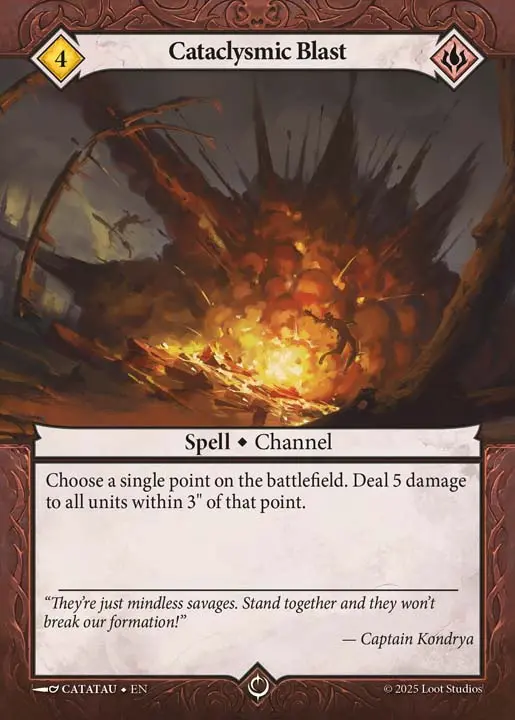
The list finished tied for second at GenCon going 3-1, with the only loss coming round 1 against the eventual champion Austin, a Londriel deck that ran 4-0. This deck is shutdown by killing the boars early or countering the key spell that would get the chain started. Londriel doesn't have much trouble doing either of those things.
Round 2 was against another Londriel list, this time In'Gor won that game 48-2. The Londriel list was built slightly different than the typical one, with more midrange units and fewer protection pieces, pushing it away from a pure control shell toward midrange.
A control-heavy deck has an easier time countering the key spell at the right moment or killing the critical unit before the chain can get started. Smaller units and less protection make a deck far more vulnerable to a chain reaction to occur, making you much more susceptible to the chain reaction of damage.
The score reflects this In'Gor deck's ability to pivot into an aggressive style instead of the sacrifice combo deck. You don't always have to kill your own stuff to win.
Round 3 was against Thundersteps, In'Gor winning 51-25. The nice thing about the Thundersteps matchup for almost any Seeker is that you know what Thundersteps' game plan is, charge your units.
As a combo deck that predictability is an advantage. You can slow down the game and do more setup on your side of the board to ensure an effective execution of your chain reaction since you know Thundersteps is coming to you.
The final round was against Auric Evenhand, winning 48-2. It is worth noting that due to the timing of this tournament the new rules update regarding items were not in effect, items still gave Mastery. Even so, In'Gor performed again pivoting to the aggressive style deck overwhelming Auric.
Woody was the pilot and creator of this deck and he did a great job showcasing what it is capable of. A few more direct-damage or self sacrifice cards could very well turn this deck into a very serious threat when fielded.
If you want to hear some more about the deck and how it performed you can listen to the Critical Graze podcast: Gen Con 1v1 episode.
These findings are hereby entered into the Grand Archive.