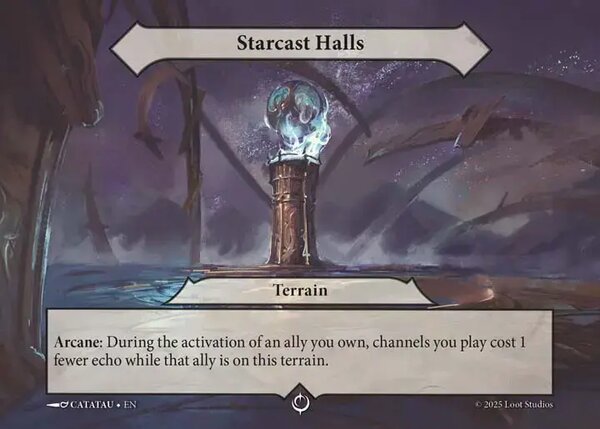
Starcast Halls is currently the most-picked terrain in the meta, taken by roughly 42.4% of players. However, most players are making their opponent stronger without realizing it.
Archivist's Log, Entry
The latest expedition records have been catalogued. While much remains uncertain, one pattern appears often enough to warrant further examination.
Before a game, players ask "what terrain benefits me most" when they build their list. The question that actually gets results is different: “what terrain will I take advantage of more than my opponent.” Terrain effects apply to whoever's standing on the piece, not whoever brought it to the table and that distinction is where a lot of good picks quietly turn into liabilities.
Consider an aggressive seeker such as Kar-Mamok (8.1% of the meta) or In’Gor (7.5% of the meta), both seem like great candidates for Starcast Halls because they run plenty of Channel spells. Their game plan is to advance quickly, pressure husks, and keep the opponent reacting. By the middle of the game, their units have moved to where the opponent has chosen to defend against the aggression.
Now picture the opponent playing a slower, more deliberate strategy. They occupy Starcast Halls for several turns, casting discounted Channel spells from a safe position while the aggressive player continues to push forward towards them.
In these examples, the terrain wasn’t helping the player who chose it. It was helping the player who could use it for longer. That’s the distinction many players miss: terrain rewards the player standing on it, not the player who included it in their list.
The appeal is obvious on paper, its Arcane effect reduces spell costs for units standing on it, which looks like a clean win for any spell-heavy list. But the discount attaches to the terrain, not the deck that brought it. Anyone standing there gets it, opponent included.
If a list runs fewer than ten Channel spells, it likely doesn't have the density to actually capitalize on the discount. And even a list that clears that bar can undercut itself by playstyle: an aggressive deck that keeps pushing forward isn't parked on its own terrain, which leaves it open for a patient opponent to camp on instead. In Kar-Mamok or In'Gor that swing can mean handing the opponent six different Starcast Halls terrain pieces over the course of a game instead of three.
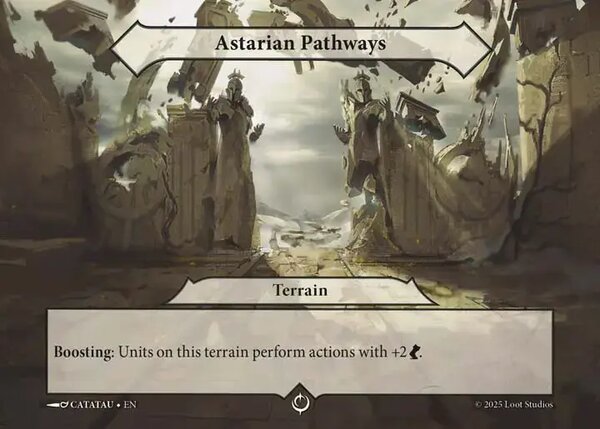
Astarian Pathways, the second most-picked terrain at 32.1%, grants a Speed boost to units that begin certain moves there. The benefit terrain applies goes both ways, an opponent standing on it goes faster too, but it costs the aggressor far less. Aggressive decks want to close distance anyway, so even when the opponent benefits from the same terrain, it isn't working against the game plan the way free spells can. A shared upside only hurts you when it's propping up the exact strategy you're trying to beat.
The obvious counter to this argument is that Starcast Halls is simply the strongest terrain card, and that a Channel-heavy list should take it without a second thought. That's true in isolation. But this cost reduction that's symmetrical tends to favour whoever plays more patiently, not whoever brought the terrain to the table. A strong tool in your hands can be an even stronger tool in your opponent's, if their deck and playstyle are built to exploit exactly what the terrain offers.
Stop asking "do I run enough Channel spells to justify Starcast Halls." Start asking "will I actually take more advantage of this terrain than my opponent will, across the majority of my matchups." That shift in framing is the difference between a pick that wins games and one that quietly hands them away.
The finest Seekers test more than their opponents; they test the strength of accepted wisdom. Every victory and defeat adds another lesson worthy of preservation.
These findings are hereby entered into the Grand Archive.